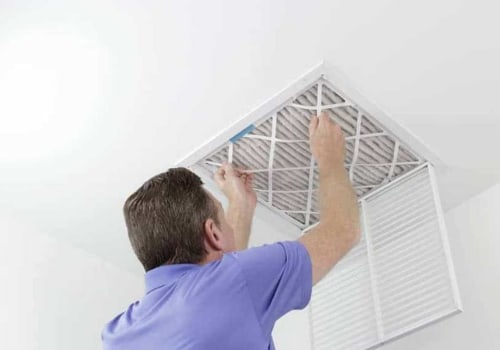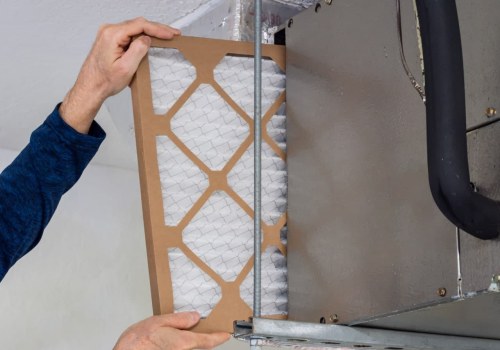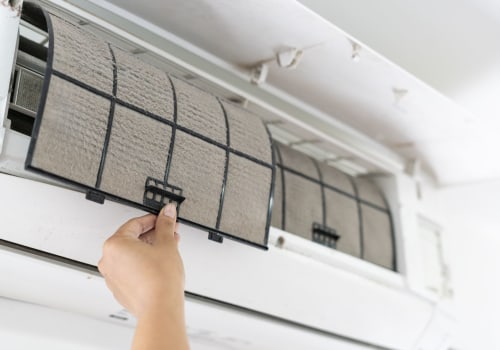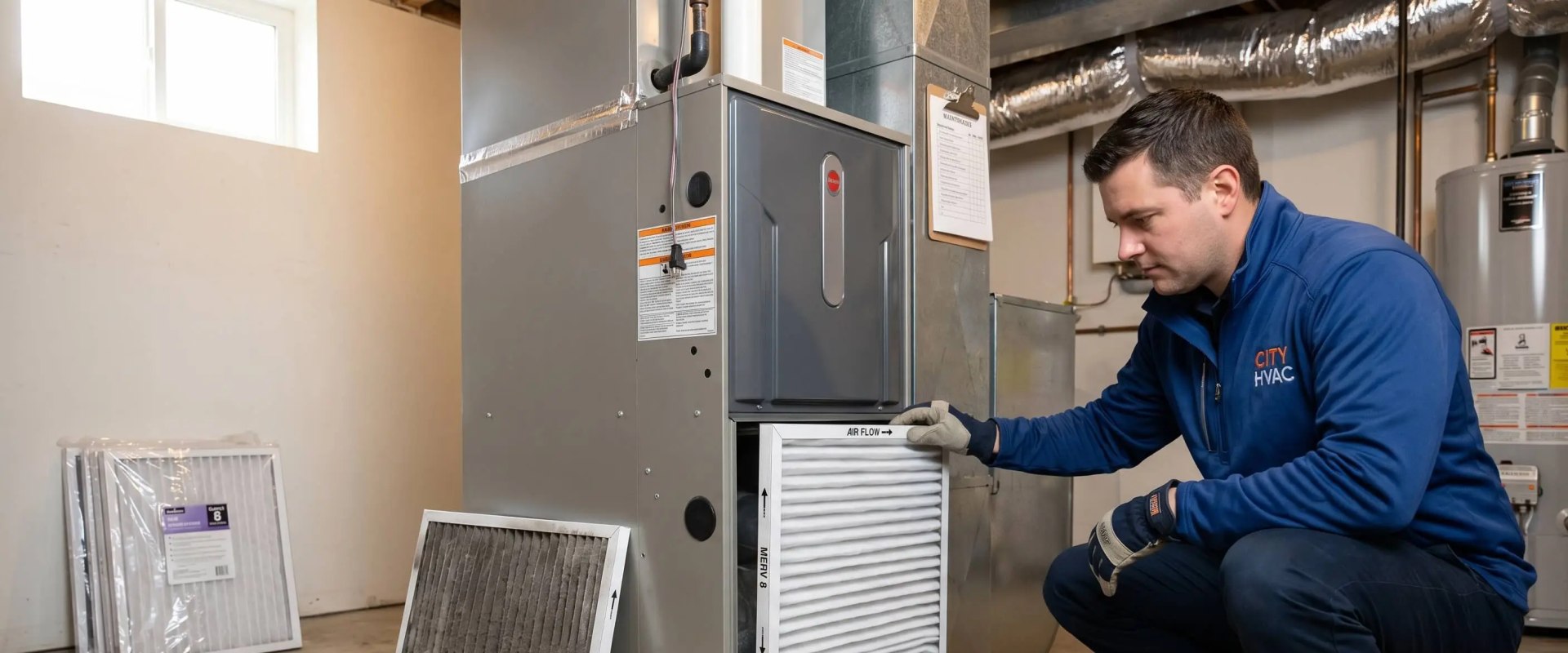
Pull a filter that’s been installed backwards for a heating season, and you can usually tell at a glance. The media has warped outward toward the supply duct, the downstream face shows dust the intake side should have caught, and somewhere in the house there’s a faint whistle at the return grille that the homeowner stopped noticing months ago. The positive insight when checking which way does air filter go in furnace is simple: the fix takes ten seconds, the arrow on the filter frame points toward the blower motor, in the same direction air moves through your system. That rule holds for every furnace orientation: upflow, downflow, and horizontal.
TL;DR Quick Answers
Which Way Does Air Filter Go in Furnace?
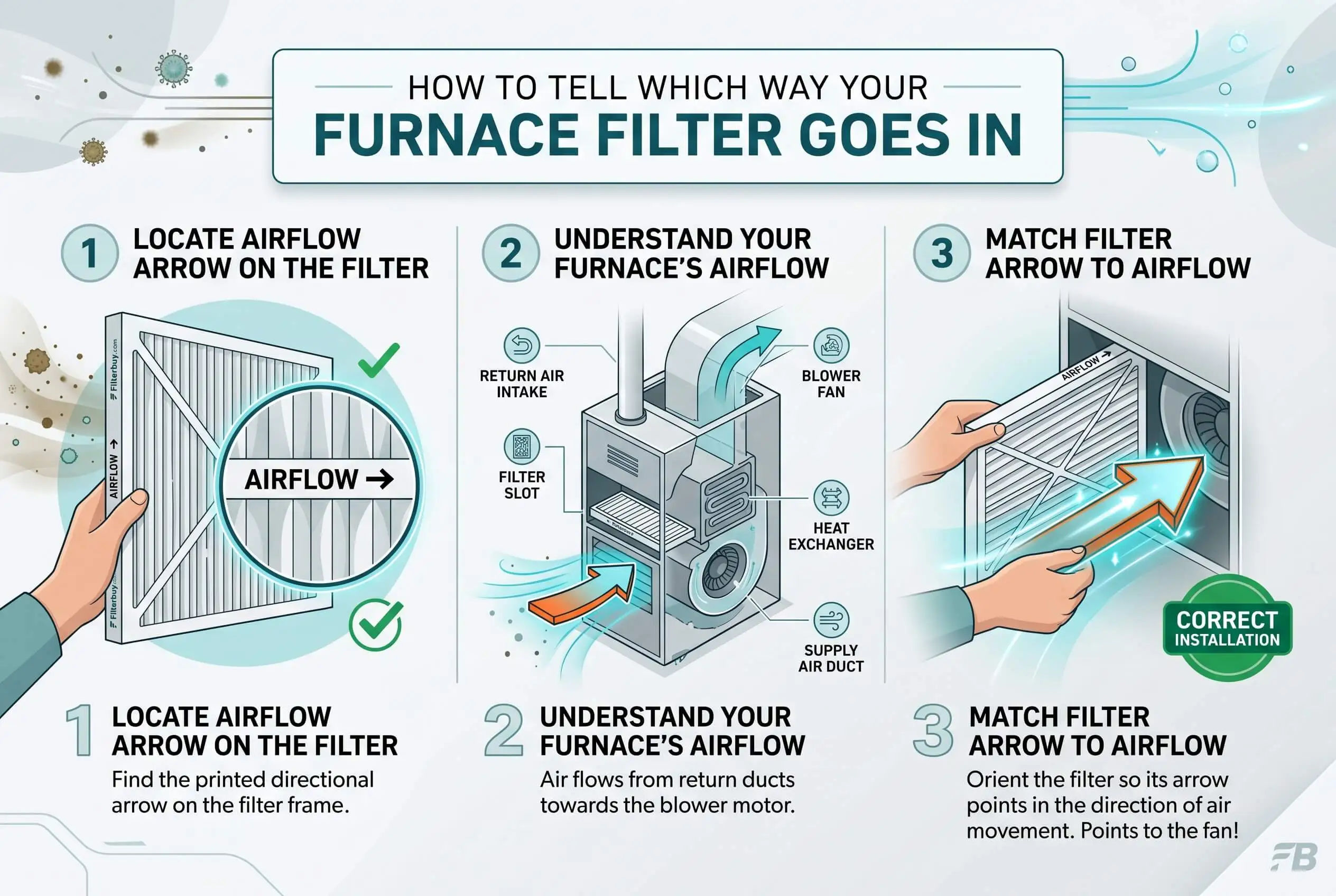
The arrow printed on your furnace filter frame points toward the blower motor, in the same direction air flows through your HVAC system. That rule holds for every furnace orientation. Upflow furnaces point the arrow up, downflow furnaces point it down, and horizontal furnaces point it sideways toward the fan.
Arrow points toward the blower, away from the return. This direction never changes regardless of furnace type or installation location.
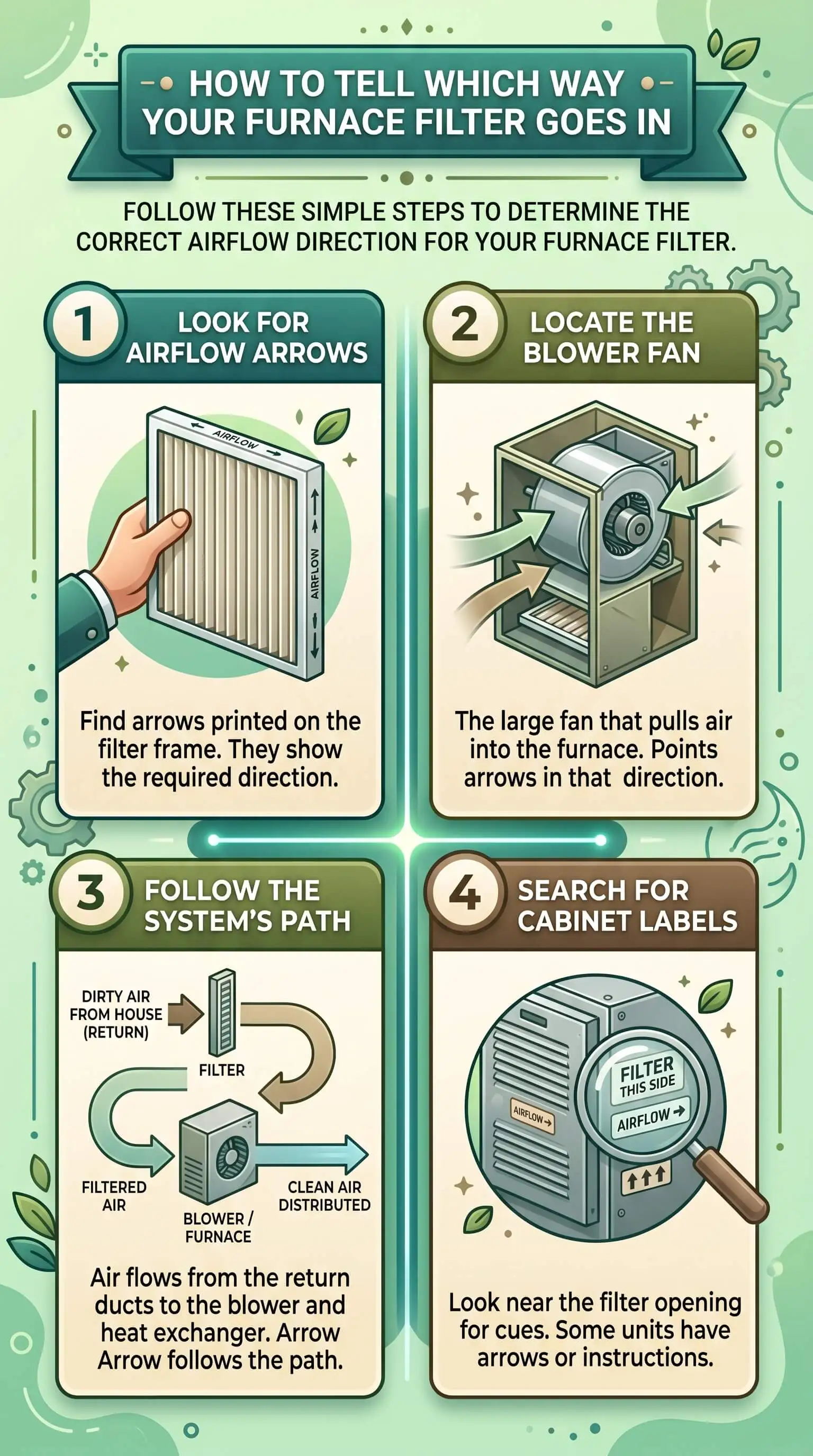
When the arrow is missing or faded, follow the texture. The looser, more open face goes toward the return vent. The denser face and any wire backing go toward the blower.
A backwards install can cut HVAC efficiency by up to 15% per ENERGY STAR, while keeping the furnace running normally enough that most homeowners never catch the damage until the utility bill arrives.
Top Takeaways
The arrow points toward the furnace blower. Air moves from the return vent through the filter to the fan, and the arrow follows that path in every furnace configuration.
A backwards filter restricts airflow significantly. ENERGY STAR counts airflow problems among the issues that can cut HVAC efficiency by up to 15 percent.
When the arrow is missing, follow the texture. The looser, more open face goes toward the return vent. The denser face and any wire backing go toward the blower.
Check monthly, replace every one to three months. A filter loaded with debris causes the same airflow problems as a backwards install, even when oriented correctly.
How to Read the Arrow on a Furnace Filter
Pick up your filter and rotate it so you can see the long edges. The arrow is usually printed in white or black ink on one of those edges, often with ‘airflow’ stamped beside it. The arrow tells you which way the air flows through the filter media, not which way the frame slides into the slot. Confusing those two questions is the most common reason filters end up reversed.
In a standard residential setup, air follows a one-way path. It enters through return vents in your living space, gets pulled through the filter media, and arrives at the blower motor. The direction of that pull — down, up, or sideways — depends on whether the furnace is upflow, downflow, or horizontal. From the blower, the air heats or cools and then pushes back out through the supply registers in every room.
The arrow on your filter has to match that one-way flow. It points toward the blower and away from the return. Think of it like a road sign on a one-way street: the air goes that way, and the arrow points where the air is going.
The U.S. Department of Energy notes that dirty or restricted filters reduce airflow and system efficiency. Reversing the filter creates the same problem from the other direction: the layered media only works when air hits it in the order the manufacturer designed.
Which Way the Arrow Points by Furnace Type
Most homes have one of three furnace orientations, and the arrow direction shifts a little with each.
Upflow systems are the standard install in basements and ground-floor utility closets, especially in colder regions where the furnace shares a wall with the water heater. Air enters at the bottom of the cabinet, passes through the filter, climbs into the heat exchanger, and feeds ductwork on the floors above. The arrow points up.
Downflow systems sit in attics or on upper floors and push conditioned air down into the living space below. The arrow points down.
Horizontal systems are what we see most often across our Central Florida service calls. The air handler lies on its side in an attic or a tight utility closet, air moves sideways through the filter, and the arrow points left or right toward the blower depending on which way the installer sets the cabinet.
Whatever the orientation, the rule never changes: the arrow points toward the blower. If you know where the fan sits and which side of the filter carries the arrow, you can install it right every time without pulling the manual.
What to Do When the Arrow Is Missing or Faded
Older filters and some lower-cost brands either skip the airflow arrow or print it in ink that fades after a few months in warehouse storage, which can make furnace filter cost only part of the buying decision. We pull plenty of these out of Florida homes every week. The workaround is a three-part visual check.
First, run your hand across the two faces of the filter. One side feels looser, almost like the surface of a kitchen sponge — that side is the intake, and it faces the return vent where the dirtiest air enters. The opposite face feels denser, sometimes almost fuzzy. The denser side faces the blower.
Second, look for a wire backing or reinforcing mesh. Pleated filters often have a metal grid stamped onto one face. That grid supports the downstream side, so it always faces the blower.
Third, when the two cues conflict or you genuinely can’t tell, follow the air. The filter should sit so the denser face and any wire backing end up on the blower side, with the looser face toward the return.
Signs Your Filter Is Installed Backwards
A backwards filter doesn’t stop a furnace from running. That’s exactly why so many homeowners go months without noticing. We’ve pulled filters that were reversed for an entire heating season, and the system kept running, the house kept heating, and the only signs were the ones the homeowner had quietly stopped noticing because they came on a degree at a time.
Here’s the diagnostic we walk through on a service call when we suspect a backwards install:
Visible bowing of the media. Air pushing against the dense side first warps the filter outward toward the supply duct. A correct install stays flat, or pulls gently toward the blower side.
Whistling or new airflow noise at the return grille. Restricted intake makes the kind of audible turbulence a correctly oriented filter doesn’t produce.
Dust collecting on the wrong face. The intake side should always look dirtier. If the downstream face is the dirty one, the filter’s been pulling debris through itself backward for a while.
Longer run times at the thermostat. When the blower fights the dense media, it stays on longer to reach setpoint — most noticeably on cold mornings or peak afternoon heat.
Any one of these is worth a check. Two or more, and the filter’s almost certainly backwards.
Why Direction Matters for MERV-Rated Performance
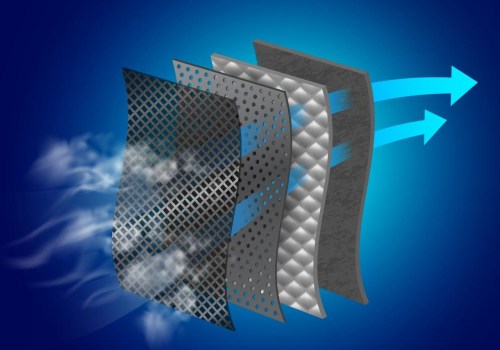
Manufacturers build furnace filter media in deliberate layers. The intake side uses an open, loosely woven material that catches the largest debris like pet hair, lint, and visible dust. As air moves deeper into the filter, the layers get progressively denser, capturing smaller and smaller particles until the air leaving the blower side is substantially cleaner than the air going in.
That layered design is what produces the filter’s MERV rating. A MERV 11 catches fine dust, pollen, and pet dander. MERV 13 goes further, picking up smaller respiratory particles and a meaningful fraction of bacteria-sized matter. All those ratings assume air moves through the layers in the order the manufacturer built them in: intake side first, dense side last.
Reverse the filter, and air hits the densest layer first. Pressure drop rises, the larger particles never get a chance to settle in the open intake side, and the staged capture sequence collapses. The filter still moves air. It just moves less of it, less cleanly, while making the blower motor work harder to push the same volume.
For the full installation walkthrough, including wall-mounted return vents, snug-fit verification, high quality air filters, and the edge cases we couldn’t fit here, our step-by-step furnace filter installation guide covers every configuration.
“In the field, that ten-second pause to find the arrow prevents more system damage than any other piece of advice we give homeowners. Most of the backwards installs we find weren’t done carelessly. They happened during a hurried filter change when the previous filter’s arrow had faded, and the homeowner had to guess. Two minutes to verify direction protects months of efficient operation.”
Essential Resources
When homeowners ask where we go for solid background reading on furnace filtration, this is the short list. Each one is either a government agency, the definitional reference, or the deeper installation guide that pairs with this article.
Our furnace filter installation walkthrough. Step-by-step setup covering filter slot location, sizing, MERV selection, and direction verification across upflow, downflow, and horizontal systems. filterbuy.com/resources/air-filter-maintenance/way-furnace-filter-go
Wikipedia: Air filter. Definitional overview of how mechanical, electrostatic, and HEPA filtration media work across residential and industrial applications. en.wikipedia.org/wiki/Air_filter
U.S. Department of Energy: Air Conditioner Maintenance. Official guidance on how filter cleanliness affects airflow, evaporator coil performance, and overall system efficiency. energy.gov/energysaver/air-conditioner-maintenance
ENERGY STAR: Maintenance Checklist. Homeowner reference for monthly filter inspection and the full set of safety and efficiency tasks a qualified contractor performs on a tune-up. energystar.gov/saveathome/heating-cooling/maintenance-checklist
ENERGY STAR: Heat & Cool Efficiently. Broader resource on how heating and cooling decisions affect roughly half of household energy use, including filter replacement cadence. energystar.gov/saveathome/heating-cooling
EPA: Guide to Air Cleaners in the Home. Consumer-grade explainer covering portable air cleaners and HVAC filters, including MERV 13 selection criteria for residential systems. epa.gov/indoor-air-quality-iaq/guide-air-cleaners-home
EPA: Air Cleaners and Air Filters in the Home. Broader EPA resource hub on residential filtration as a supplement to source control and ventilation. epa.gov/indoor-air-quality-iaq/air-cleaners-and-air-filters-home
Supporting Statistics
Up to 15% efficiency loss from airflow problems. ENERGY STAR’s residential maintenance checklist counts airflow restriction, which is exactly what a backwards filter creates, among the issues that can cut HVAC efficiency by as much as 15 percent. Source: ENERGY STAR Maintenance Checklist.
Monthly inspection, quarterly replacement at minimum. ENERGY STAR’s guidance is to check your furnace or AC filter every month during heavy-use seasons, and to replace it at minimum every three months whether or not it looks visibly dirty. Source: ENERGY STAR Heat & Cool Efficiently.
About 90% of my time is spent indoors. EPA estimates that most Americans spend roughly 90 percent of their time indoors, which is exactly why properly installed HVAC filtration shows up in the agency’s recommended approach to better indoor air. Source: EPA Guide to Air Cleaners in the Home.
Final Thoughts
Across hundreds of service calls in Florida homes, the same pattern keeps surfacing. Furnace filter replacement is the simplest HVAC task to get right, and it’s the one homeowners miss most often. The arrow takes ten seconds to find. Texture and wire backing add maybe another ten. Once those cues are familiar, you can verify any filter in any furnace configuration without the manual, and a properly installed filter quietly does its job every cycle the system runs.
Frequently Asked Questions
Which way should the arrow on a furnace filter face?
Toward the blower motor, in the same direction air is moving through your system. For an upflow furnace, that means the arrow points up. Downflow furnaces point it down. Horizontal furnaces, the most common attic-mounted configuration in Florida, point it sideways toward the fan.
What if my furnace filter has no arrow?
Look at the texture. The looser, more open face goes toward the return vent where dirty air enters. The denser, sometimes fuzzy face goes toward the blower. If you see a wire backing or reinforcing mesh stamped on one side, that wire faces the blower too. When all else fails, orient the filter so air flows from the open side to the dense side.
Does it matter which way the pleats face?
No. Pleats themselves don’t tell you anything about direction. The reliable orientation cues are the arrow on the frame, the denser media face, and the wire backing on pleated models. Air moves through pleats in either direction equally well, so don’t use pleat shape as a guide.
What happens if I install my furnace filter backwards?
Airflow restriction goes up immediately, the layered media stops working in the order the manufacturer built it for, and the blower has to push harder against the dense side. The system isn’t broken, just less efficient. Over weeks and months, longer run times, higher utility bills, and extra wear on the motor start adding up. Most furnaces keep running with a backwards filter, which is why the problem usually goes unnoticed until the next service call or an unexpected energy bill.
Does the arrow direction change for upflow versus downflow furnaces?
The rule stays the same: the arrow always points at the blower. What changes is which physical direction that points you. Upflow furnaces put the blower above the filter, so the arrow points up. Downflow furnaces put it below, so the arrow points down. Horizontal furnaces have the blower off to one side, so the arrow points left or right depending on which way the installer sets the cabinet.
Getting Furnace Filter Direction Right, Every Time
Getting filter direction right is the smallest piece of HVAC maintenance you’ll ever do, and it’s one of the few that pays back on every cycle the system runs by helping the furnace operate more efficiently and supporting a smarter, longer-term furnace replacement timeline. For the full walkthrough, including wall-mounted return vents, snug-fit verification, MERV interaction with airflow, and every edge case we couldn’t fit here, our full furnace filter direction guide has the rest of it.
In an article about How to Tell Which Way Your Furnace Filter Goes In, it’s helpful to connect installation direction with choosing the right replacement filter, because the arrow only does its job when the filter size and fit are correct. Options like 12x24x2 furnace filters, 23.5x23.5x1 HVAC air filters, and 14x30x1 furnace filters fit naturally into the topic because homeowners need to confirm the correct size, slide the filter in snugly, and point the airflow arrow toward the blower so the furnace can move air cleanly and efficiently through the system.